
How can innovative ammonia and methanol technologies work when renewable electricity and hydrogen supply fluctuate? And how can promising reactor concepts be translated into viable industrial plants?
These questions were at the centre of ALCHEMHY’s participation in the 4th NEFI Conference 2026, held on 22–23 October at the MuseumsQuartier in Vienna under the theme “Future Industry – Innovating for Competitiveness”. The conference brought together research, industry and policy stakeholders to discuss practical pathways towards a competitive, climate-neutral European industry, with topics ranging from electrification and hydrogen to industrial flexibility, CCU and new business models.
Christoph Zauner from AIT Austrian Institute of Technology, together with Philipp Moser and Michal Rezucha, presented “Selected Results of the European Project ALCHEMHY on the Carbon-Neutral Production of E-Methanol and E-Ammonia.” The contribution formed part of the session “Advanced Production and Conversion Pathways for Hydrogen and E-Fuels”, which focused on advanced reactor technologies, process modelling and system optimisation for low-carbon fuels and chemicals. ALCHEMHY is developing electrified production routes for two fundamental platform chemicals: ammonia and methanol. The project combines new reactor concepts with renewable hydrogen, process intensification, renewable-energy integration and digital tools, with the overall aim of advancing the technologies towards industrially relevant demonstration. At NEFI, Christoph introduced the project’s ammonia and methanol technology pathways, including the Magnetic-Heated Sorption-Enhanced Reactor (MSER), Direct Electrochemical Synthesis of Ammonia (DESA), the Small-Flexible Methanol Reactor (SFMR) and the project’s plasma-based route for CO₂ conversion and syngas production.
However, the presentation went beyond the individual reactors.
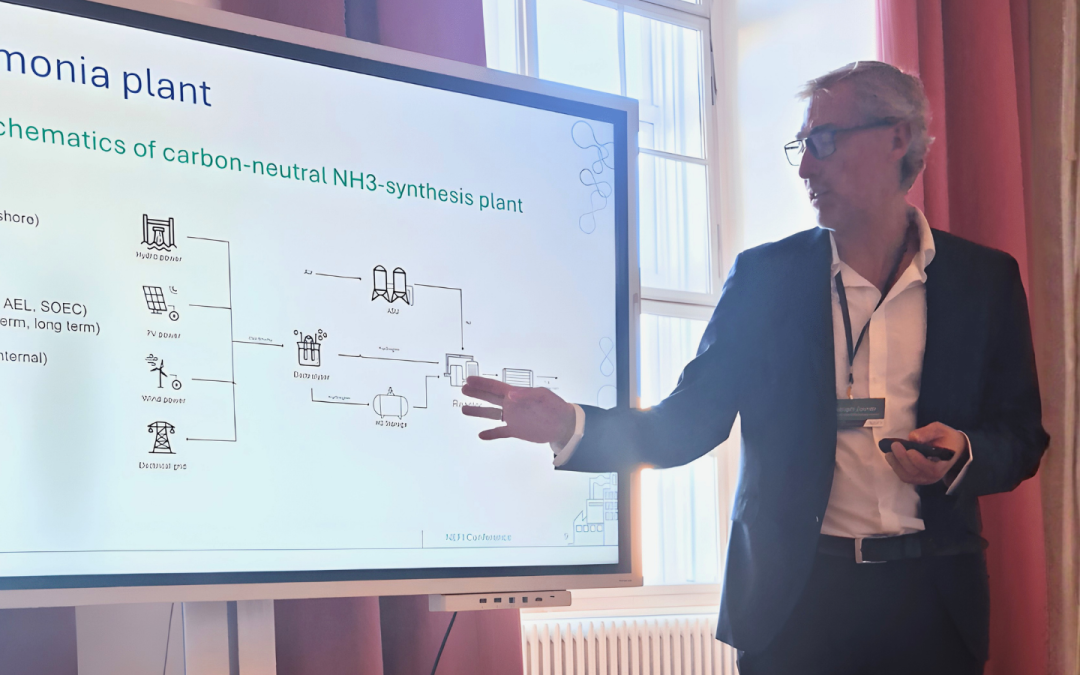
A key focus was how these technologies can become part of an integrated renewable production system. The plant concepts presented by AIT connect renewable electricity from sources such as solar and wind with electrolysers, hydrogen storage and compression, and the new ammonia or methanol synthesis processes. For methanol, the wider system also considers CO₂ supply and downstream conversion pathways. This system perspective is particularly important because future renewable-based chemical plants will not necessarily operate under the stable conditions associated with conventional fossil-based production. Within ALCHEMHY, AIT is developing dynamic process models that can explore how the plants respond to changing operating conditions and variable renewable hydrogen supply. Christoph presented examples of the modelling of the MSER and SFMR processes in Modelica/Dymola, including process flows, energy and material balances and the interaction between different plant components. This work helps the consortium investigate questions that are essential for industrial scale-up: How does a process respond when hydrogen availability changes? Where are the main energy requirements? How can heating, cooling and process integration be improved? And what plant configuration provides the best balance between efficiency, flexibility and practical operation?
ALCHEMHY places this system-level modelling at the heart of the project, supporting the integration of renewable generation, electrolysis, storage and chemical synthesis while studying dynamic operation under changing input conditions. The resulting models will also contribute to the project’s wider digital-twin and decision-support activities.
The presentation also highlighted the next important step: connecting technical simulation with techno-economic assessment. For the methanol pathway, AIT presented an exemplary analysis of the levelised cost of e-methanol and outlined further work on plant optimisation, integration of the industrial refinery use case and comparison with state-of-the-art production routes. This combination is particularly relevant to ALCHEMHY stakeholders. A new technology does not become industrially attractive simply because a reactor performs well. Its future deployment will also depend on the cost and availability of renewable electricity and hydrogen, plant configuration, infrastructure requirements, flexibility, investment needs and integration within existing industrial value chains.
The discussions at NEFI reflected this interest. Following the presentation, Christoph exchanged views with representatives from companies and research organisations who were particularly interested in ALCHEMHY’s full plant simulation approach and emerging techno-economic assessment capabilities, as well as the results that will become available as the project progresses. For ALCHEMHY, this engagement is an important part of moving from innovative technologies towards credible industrial pathways: combining reactor development with modelling, system integration and economic assessment to understand not only whether new e-ammonia and e-methanol processes can work, but how they could eventually work in real industrial environments.