
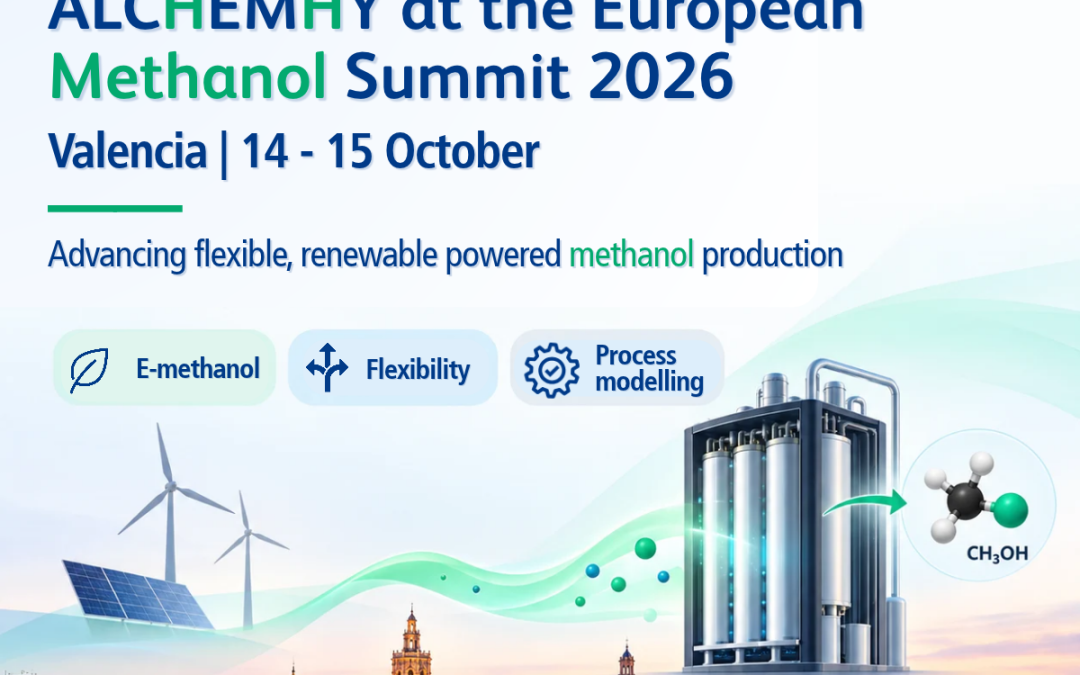
ALCHEMHY recently took part in the European Methanol Summit, where project partner AIT Austrian Institute of Technology engaged with industry representatives, technology providers and EPC companies to discuss the evolving outlook for renewable methanol and the technologies needed to support its future deployment.
The discussions highlighted a sector that is gaining momentum, but where important uncertainties remain. While the future scale of the e-methanol market is still developing, the project pipeline is growing, with some facilities already reaching final investment decisions and moving into operation. At the same time, securing long-term offtake agreements remains one of the main non-technical challenges for renewable methanol projects. Voluntary willingness to pay a premium for lower-carbon products is unlikely to be sufficient on its own, reinforcing the importance of regulatory measures and demand-side instruments such as those introduced through ReFuelEU.
Another recurring topic was the challenge of operating methanol production alongside fluctuating renewable electricity and hydrogen supply. This is directly relevant to ALCHEMHY, which is developing electrified and flexible production concepts for methanol and ammonia that are intended to support closer integration with renewable energy generation. The project combines process development with dynamic modelling, digital tools and techno-economic assessment to investigate how these technologies could operate and scale within future industrial energy systems.
During the Summit, AIT presented and discussed its latest work on detailed process simulation and techno-economic evaluation with potential EPC and technology suppliers. These exchanges generated strong interest and provided valuable industry feedback on how modelling tools can support the design and assessment of future renewable methanol projects.
Within ALCHEMHY, AIT leads work on the simulation of process flexibility and renewable-energy integration, modelling the complete production system from renewable electricity and electrolysis through hydrogen storage and chemical synthesis. The approach is designed to analyse dynamic operation under changing inputs, including start-ups, shutdowns and fluctuations in energy and feedstock availability. This modelling work complements the project’s broader ambition to demonstrate innovative production routes at TRL 6 and assess their technical and economic feasibility in relevant industrial use cases.
Importantly, the discussions did not end at the conference. Dedicated follow-up meetings have already been arranged with interested stakeholders to further develop the modelling and assessment tools and explore their application both within the ALCHEMHY use cases and in other future projects.
The exchanges at the European Methanol Summit reinforced an important message for ALCHEMHY: the transition towards renewable methanol will depend not only on producing low-carbon molecules, but also on developing flexible, economically viable and industry-ready production systems capable of responding to a changing energy market.