
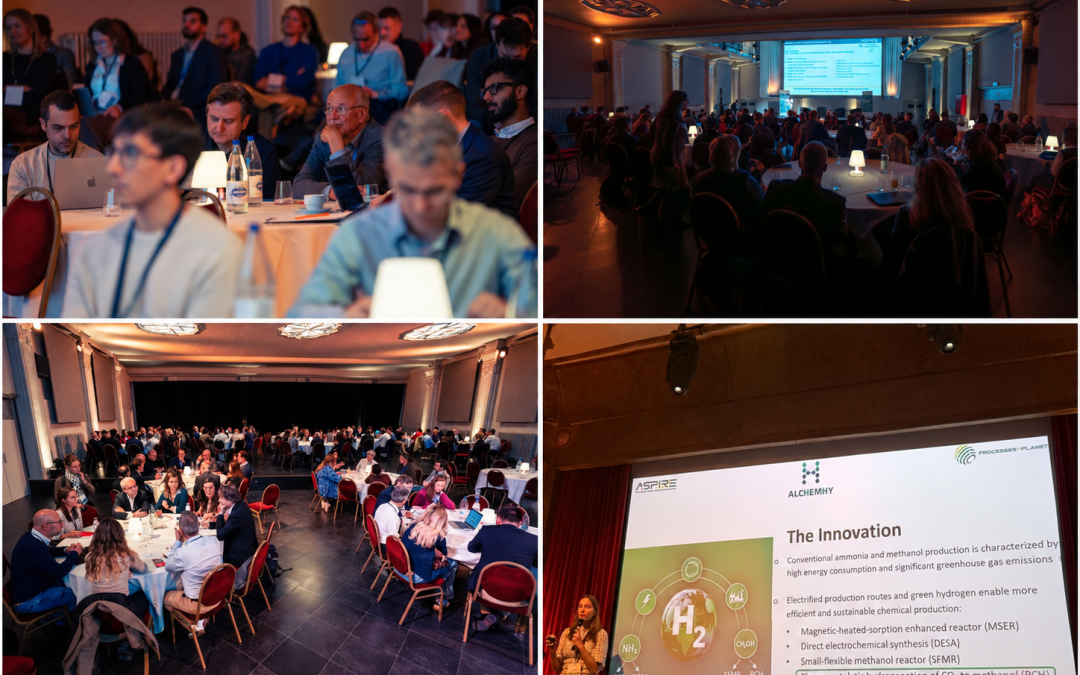
On 21–22 October 2026, the ALCHEMHY project joined the A.SPIRE Industrial Innovation Days 2026 in Brussels, contributing to discussions on the technologies and collaborative approaches needed to support the transformation of Europe’s process industries.
A.SPIRE is the European association representing the private side of the Processes4Planet (P4Planet) co-programmed Partnership, established together with the European Commission under Horizon Europe. Bringing together companies and research organisations from across Europe’s process industries, A.SPIRE supports the development and deployment of technologies that can strengthen industrial competitiveness while advancing climate neutrality and circularity. ALCHEMHY is directly connected to this community, as the project is funded under the Horizon Europe Processes4Planet topic on renewable hydrogen used as feedstock in innovative production routes.
This relationship made the Industrial Innovation Days a particularly relevant opportunity for ALCHEMHY to exchange knowledge with other P4Planet projects and engage with the wider European process-industry community. The 2026 event brought together more than 130 participants and combined strategic discussions on the future of the process industries with project showcases, networking and exchanges on pathways from research and innovation towards industrial deployment.
ALCHEMHY was represented by Elena Pollet from the University of Antwerp, who contributed to the workshop “Low-carbon production of minerals and materials”.
The session brought together five European projects (ALCHEMHY, ELECTRA, HYPER, MECALO and PRIM-ROCK) followed by a joint question-and-answer discussion. This provided an opportunity to compare different technological approaches and explore how research and innovation can contribute to the decarbonisation and long-term competitiveness of European industry.
During her presentation, Elena introduced ALCHEMHY’s overall mission and its portfolio of innovative technologies for the production of ammonia and methanol using hydrogen as a feedstock. She then focused on the project’s plasma-catalytic route, presenting the work carried out so far, the next steps in its development and the potential of plasma-based approaches for more sustainable methanol production.
The contribution highlighted how ALCHEMHY is combining novel reactor concepts, electrification and renewable hydrogen to explore alternative production pathways for two of the chemical industry’s most important platform chemicals. The project is also investigating how these technologies can become more flexible and better suited to an industrial energy system increasingly based on variable renewable electricity.
The discussion following the presentations also raised a broader question that is central to the transition of the process industries: does the emergence of a more sustainable technology necessarily mean that existing technologies must disappear?
Participants discussed how established and emerging technologies may instead coexist, serving different applications and market segments. Even where an innovative technology is not yet able to compete economically with the incumbent solution in every application, its environmental performance and potential to address specific industrial needs may justify gradual or targeted adoption.
This perspective is particularly relevant for projects such as ALCHEMHY. The transition towards climate-neutral industry is unlikely to depend on one single technological solution. Rather, progress will require a combination of technologies that can respond to different industrial conditions, energy systems and value chains, while progressively demonstrating their technical, environmental and economic value.
The Q&A session also offered an opportunity to increase the visibility of the wider ALCHEMHY work. When questions arose about other project technologies, including the Magnetic-Heated Sorption-Enhanced Reactor (MSER) for ammonia production, participants were directed towards the ALCHEMHY website and newsletters for further information. Participation in the A.SPIRE Industrial Innovation Days therefore provided ALCHEMHY with more than an opportunity to present its technical progress. It strengthened the project’s connection with the wider Processes4Planet community, enabled direct exchange with complementary European initiatives and contributed to the broader discussion on how promising research results can move towards industrial application.
As ALCHEMHY continues the development and validation of its innovative ammonia and methanol production routes, exchanges of this kind will remain important for connecting technological progress with industrial needs, identifying synergies with other projects and supporting the transition towards a more sustainable and competitive European process industry.
Τhe presentations shared on 22 October are available via the following link.
Photos courtesy of A.SPIRE, sourced from the A.SPIRE website.