
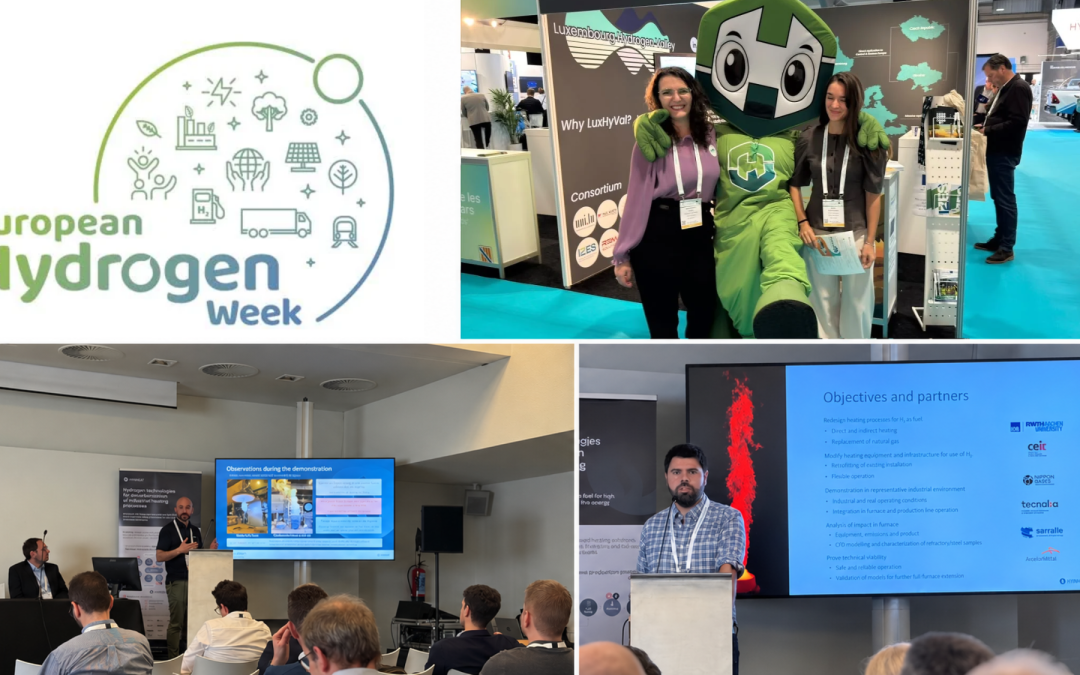
ALCHEMHY joined the European hydrogen community in Brussels this October during European Hydrogen Week 2026, represented by Maria Kontogianni from White Research, which leads the project’s communication and dissemination activities. Held under the theme “Scaling Hydrogen, Strengthening Resilience”, the event brought together policymakers, industry, researchers, technology developers and EU-funded projects to discuss how Europe can move from hydrogen innovation towards wider industrial deployment. For ALCHEMHY, which is developing new electrified routes for ammonia and methanol production using hydrogen as a feedstock, the event offered a valuable opportunity to connect the project’s work with wider discussions on renewable hydrogen demand, industrial use, regulation, funding and market uptake.
A key part of the visit was the final event of the HyInHeat project, “Switching the Flame: Hydrogen for Energy-Intensive Industry – Steel and Aluminium”. Although HyInHeat focuses mainly on hydrogen as a fuel for industrial heat, while ALCHEMHY uses hydrogen as a chemical feedstock, both projects face similar questions around industrial integration, cost, infrastructure, regulation and the transition from technical demonstration to wider deployment. The event therefore provided useful insights into the conditions needed for hydrogen-based technologies to move beyond research and become viable industrial solutions.
European Hydrogen Week also offered the opportunity to attend sessions addressing some of the main challenges currently shaping the hydrogen sector. Discussions such as “How is RED III driving hydrogen demand in Europe?” and “The ‘must haves’: non-negotiable policies and funding schemes to unlock industrial demand” were particularly relevant to ALCHEMHY. The project sits on the industrial demand side of the hydrogen value chain, exploring how renewable hydrogen can be used in new ammonia and methanol production routes. Another relevant discussion, “Forget the colours: who is actually using hydrogen today?”, highlighted the growing focus on real applications and industrial use cases rather than hydrogen production alone. This strongly reflects ALCHEMHY’s approach: the project investigates how hydrogen can be integrated into practical chemical-production systems together with electrified reactors, process flexibility and digital tools.
ALCHEMHY also engaged with other initiatives at the EU Projects Pavilion, where projects working across the hydrogen value chain presented their activities and results. The dedicated “Industrial hydrogen use” session was especially relevant, showcasing how hydrogen is being integrated into energy-intensive industrial sectors. For ALCHEMHY, these exchanges provided useful opportunities to identify complementary projects, discuss shared challenges and explore potential synergies around industrial decarbonisation, flexibility and hydrogen integration. European Hydrogen Week reinforced an important message for ALCHEMHY: Europe does not only need more renewable hydrogen production. It also needs industrial processes capable of using that hydrogen efficiently, flexibly and competitively. As ALCHEMHY continues developing and validating its ammonia and methanol production technologies, engagement with the wider European hydrogen community will remain important for connecting research progress with industrial needs, policy developments and future market deployment.